
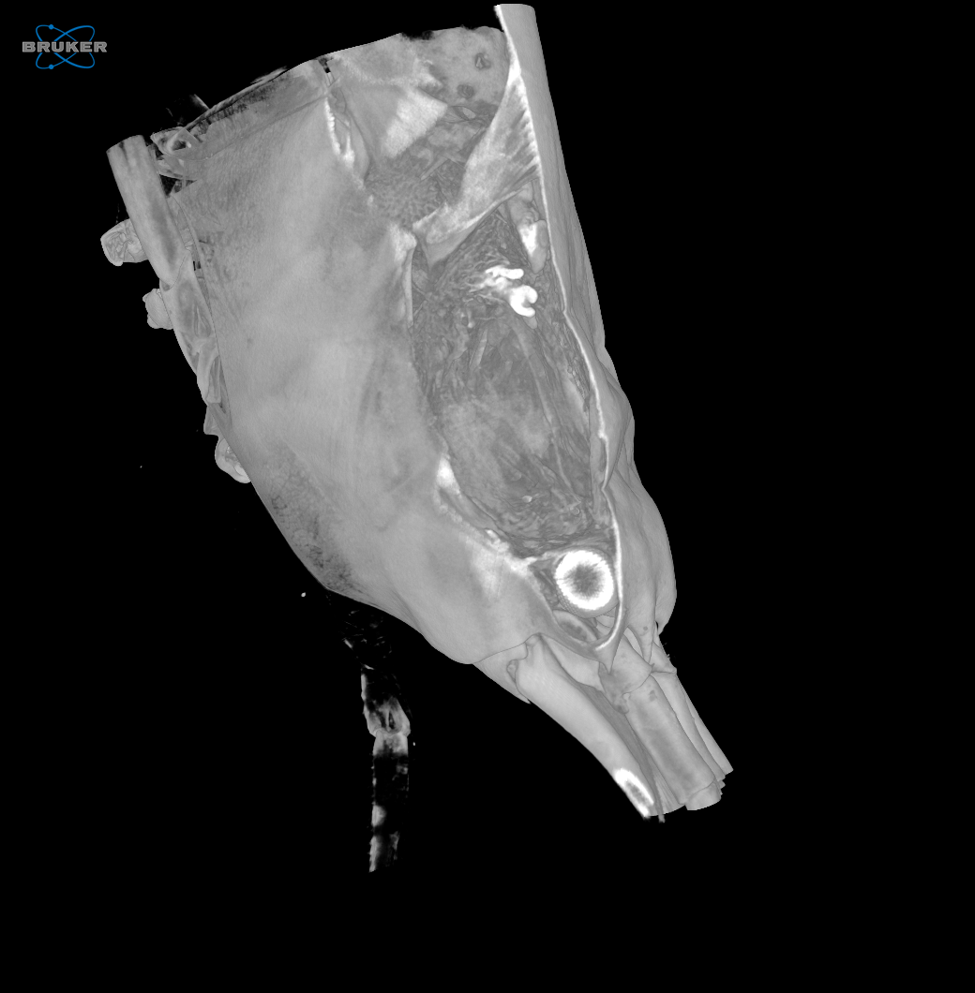
Snapping shrimp orbital hood—cutaway view, 8.2 μm
Megan Porter, PhD
Professor, School of Life Sciences
University of Hawaiʻi at Mānoa
Alexandra Kingston, PhD
Assistant Professor of Biological Sciences
The University of Tulsa
Sophia Hanscom
PhD Student in Zoology
School of Life Sciences, University of Hawaiʻi at Mānoa
Jacquelyn Benson
MS Student in Zoology
School of Life Sciences, University of Hawaiʻi at Mānoa
A collaborative team from the University of Tulsa and the University of Hawaiʻi at Mānoa is using micro-CT to investigate specialized defensive features of the crustacean exoskeleton. The broader purpose of this research is to understand the evolution of specialized features of the carapace associated with weaponry in crustaceans, i.e., how do crustaceans with weapons protect themselves from those weapons?
The researchers are examining whether specific features of the telson (tail end) influence protection and the outcome of these ritualized contests. In stomatopods, which have powerful smashing appendages for catching prey, telsons (the tail end) are used as shields in ritualized fights over burrows, where specific features of the telson may impact which individuals win or lose. In snapping shrimp, which have claws capable of cavitation as a defense and to stun prey, investigations are focused on how the carapace provides protection from their own shock waves.
Although the research projects examine different species and structures, both explore how protective anatomy may have evolved alongside increasingly powerful weaponry. The research addresses an evolutionary question: how have crustaceans with powerful weapons evolved the armor needed to survive them?
Gallery: Micro-CT Imaging of Crustacean Armor
Mantis shrimp, or stomatopods, use their powerful raptorial appendages not only to capture prey but also during contests over valuable burrows. Rather than simply absorbing an opponent’s strike anywhere on the body, an individual can curl its abdomen forward and present its heavily armored telson—the tail end of the animal—as a shield.
The telson is equipped with raised ridges known as carinae, along with spines and other reinforced features that may help distribute or withstand the force of a blow. Differences in telson armature—including possible differences between males and females—may affect how well individuals are protected and influence the outcome of ritualized contests.
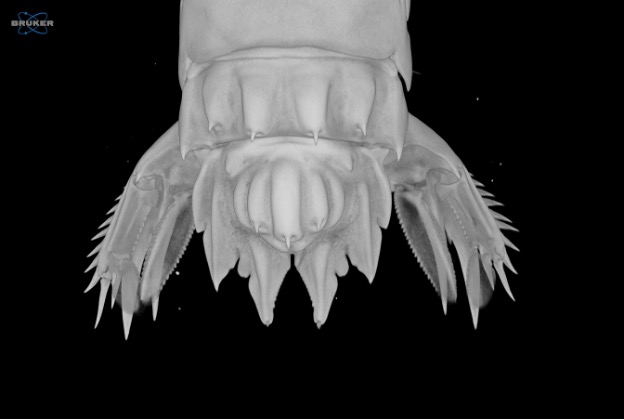
A 3D reconstruction of the telson and uropods of a female Gonodactylaceus falcatus (Figure 1) reveals the spines, carinae and other armor that form a shield during ritualized combat. These biological structures can withstand repeated, high-impact mantis shrimp strikes.
Micro-CT reconstructions of male and female Gonodactylaceus falcatus telsons allow the researchers to examine these features as complete 3D structures while preserving the spatial relationships among the telson, uropods, spines, and carinae without physically sectioning the specimen.
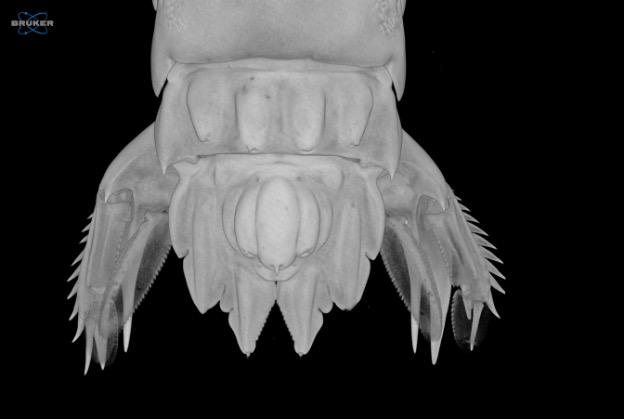
This 3D reconstruction of the telson and uropods of a male Gonodactylaceus falcatus, shows protective armature—including spines and carinae–involved in using the telson as a shield in ritualized combat. These features may help the animal withstand strikes from an opponent (Figure 2).
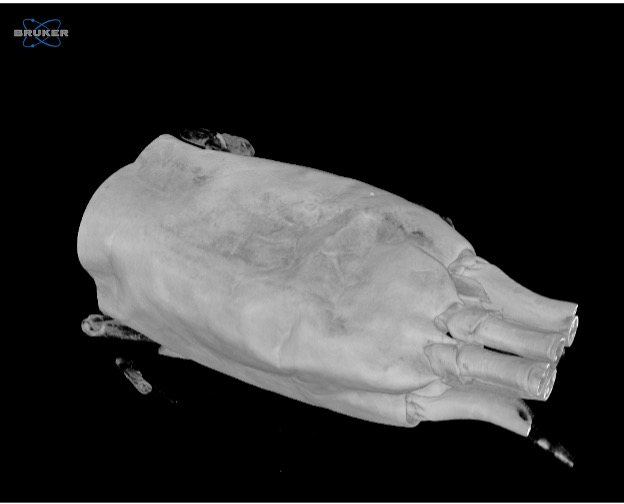
The enlarged claw of snapping shrimp can close rapidly enough to propel a jet of water that produces a cavitation bubble. When that bubble collapses, it creates sound, pressure, and a shock wave capable of stunning prey or deterring a threat.
The shrimp must also protect its own sensitive structures from forces produced close to its body. In Alpheus clamator, the carapace may provide that protection. This 3D reconstruction shows the external surface of the cephalothoracic carapace, including the orbital hood surrounding the eye region (Figure 3).
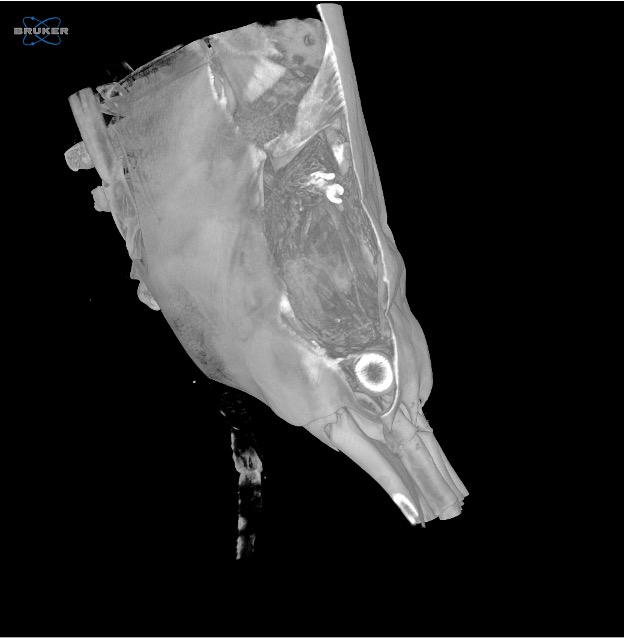
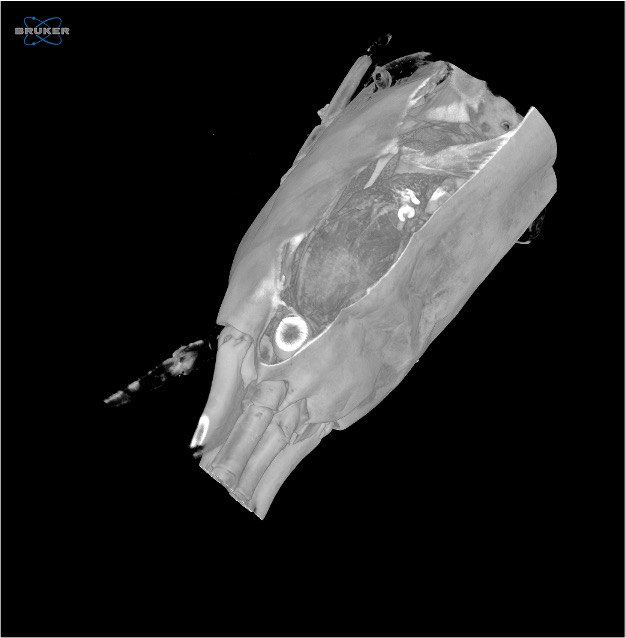
Two cutaway reconstructions of Alpheus clamator reveal structures beneath the orbital hood (Figure 4), including the compound eye and its relationship to the surrounding carapace. These internal views allow researchers to look beyond the exterior surface and investigate how the shape and organization of the carapace may reduce the eye’s exposure to shock waves generated by the snapping claw.
Together, these powerful biological systems offer opportunities to explore questions in biomechanics and evolution, with potential relevance to bio-inspired materials, robotics, and engineering.
Credits:
Megan Porter, University of Hawai’i at Mānoa, lead investigator
Alex Kingston, University of Tulsa, lead on the snapping shrimp work
Sophia Hanscom, University of Hawai’i at Mānoa, lead on the stomatopod telson work
Jacquelyn Benson, University of Hawai’i, micro-CT scanning and reconstruction
Micro-CT data generated by the University of Hawaiʻi Micro-CT Facility using a Bruker SkyScan 1272 micro-CT system.
If you are interested in being featured in a future Researcher Spotlight, please contact ann@microphotonics.com. We love to hear how our instruments are being used in the field!