
Aatif Jabbar, BS; Nahir Habet, MSc; Sarah Romereim, PhD; Bailey Fearing, PhD
Musculoskeletal Institute
Atrium Health
Charlotte, NC
There are about one million total hip arthroplasties and total knee arthroplasties performed in the United States every year, a number that is expected to grow with an increasingly aging population. Prosthetic Joint Infection (PJI) is a complication following total arthroplasty in about 1-2% of these surgeries and is responsible for about 30-40% of all failures in revision. Research to improve treatment and prevention for PJI focuses on new antibacterial coatings, surface designs, or other compounds to protect implants, with or without antibiotics.
The Orthopaedic Engineering Research Laboratory at Atrium Health applies basic engineering principles, biomechanical evaluation techniques, and new biotechnologies to orthopaedic surgery to improve clinical outcomes. The lab combines experimental mechanical studies of implantable devices and the development of rapidly translatable and novel infection interventions to address implant-associated infections. High‑resolution, non-destructive micro-CT is a key tool in their orthopaedic research program.
Micro-CT Imaging of Implant Osseointegration in Rabbit Models
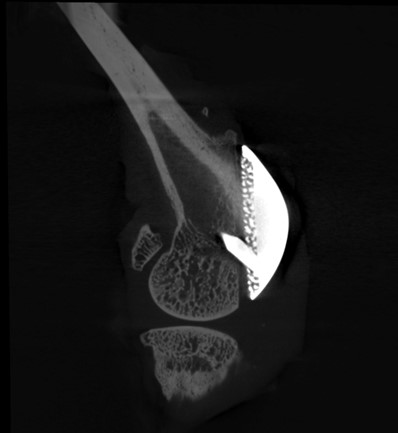
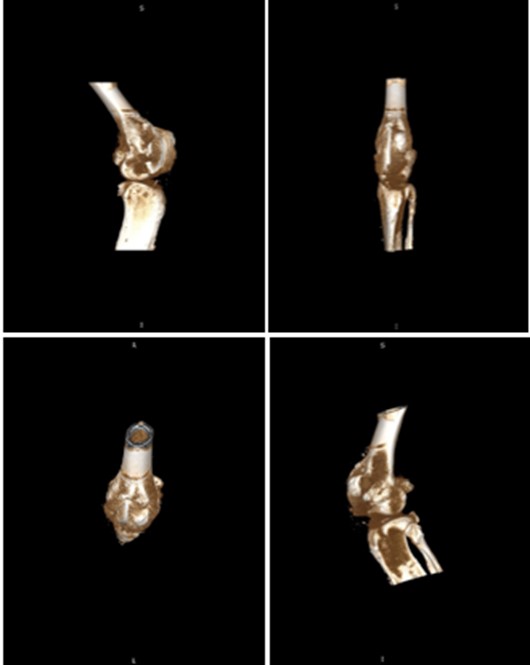
High‑resolution micro-CT enables the non‑destructive, 3D visualization of implants and surrounding bone over time. The images presented here showcase the use of micro-CT to study periprosthetic joint implantation and osseointegration in rabbit models, allowing tracking of implant positioning, bone remodeling, and early indicators of bone integration at multiple time points.
Below are micro-CT reconstructions of a femoral implant in a rabbit knee model. High-resolution imaging enables tracking of implant position and progressive changes at the implant-bone interface over time.
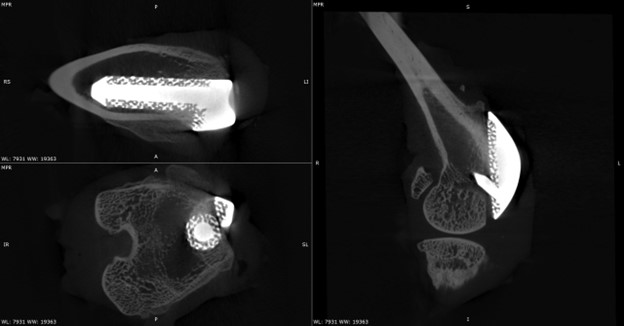
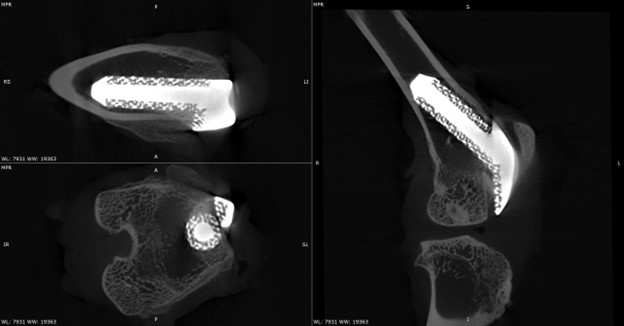
medullary cavity
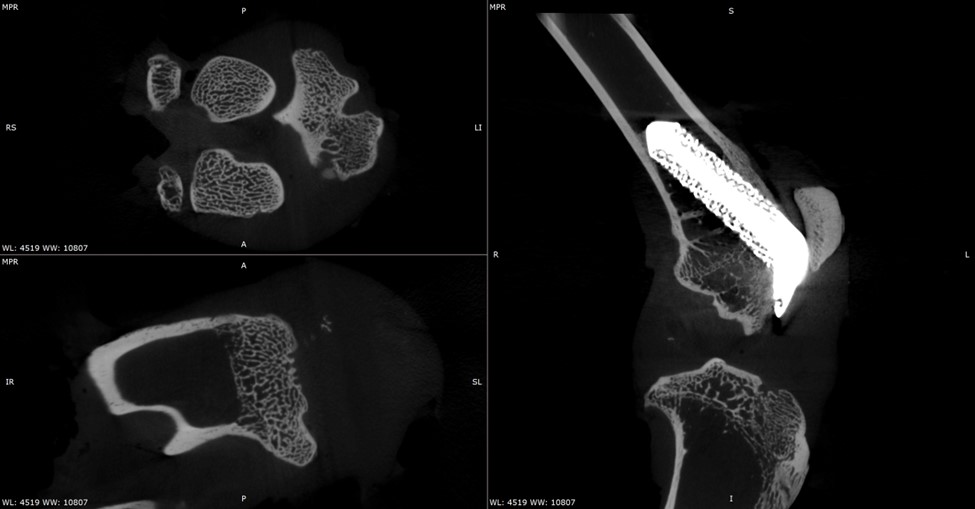
Temporal Assessment of Implant-Bone Interactions
Micro-CT imaging allows repeated scanning of the same implanted joint, providing a powerful means to observe temporal changes in bone architecture without disrupting the tissue. These scans allow monitoring of how the surrounding trabecular and cortical bone adapts to the presence of the implant, capturing subtle changes in bone volume, density, and structure as healing progresses. This approach enables precise comparison of early versus later stages of implant integration within the rabbit knee.
Orthopaedic Research at Atrium Health
The study shown here demonstrates efforts to develop preclinical models that allow testing of implants with infection challenges and overall outcomes. But much of the work from Atrium also focuses on investigating implantable device selection and optimization, as well as surgical techniques by comparing mechanical testing of multiple devices that have been developed for similar clinical applications. These studies are often performed with various orthopaedic implants, including installation and fixation of fractures and joint replacement devices in primary or revision surgeries, and anchoring devices for soft tissue reconstructions involving tendons, ligaments or joint capsule segments. Data collected is often used to evaluate initial stabilization or long-term fatigue performance and studies may utilize either surgical patient samples, synthetic or cadaveric specimens, and/or animal models. These studies typically involve the evaluation of stresses, strains, load distributions, micro motion, pressure or bone ingrowth at the fracture site or device / bone interface. The laboratory houses an extensive array of electronic instrumentation and test systems for performing experimental biomechanics studies, and micro-CT is a key tool within this lab research program.
Additional research involving micro-CT and the intersection of surgical implants and bone morphology:
Micro-CT Imaging and Mechanical Properties of Ovine Ribs
Effects of local and systemic ketorolac application on rat femur fracture healing
Development of a small animal bone-anchored limb replacement model for infection interventions – PMC
All-suture anchor pullout results in decreased bone damage and depends on cortical thickness
To contact the team, please email: Nahir.Habet@atriumhealth.org or Aatif.Jabbar@advocatehealth.org
Images scanned on a Bruker SkyScan 1273 micro-CT © 2026 Atrium Health.
If you are interested in being featured in a future Researcher Spotlight, please contact ann@microphotonics.com. We love to hear how our instruments are being used in the field!