
EduceLab at the University of Kentucky:
Dr. W. Brent Seales, Stanley and Karen Pigman Chair of Heritage Science
Dr. C. Seth Parker, Assistant Research Professor
Michael Detisch, Senior Research Associate and Technical Lead
Dr. Christy Chapman, Assistant Research Professor and Director of Operations
American Center of Research in Jordan:
Dr. Pearce Paul Creasman, Executive Director & Professor
A complementary imaging approach is helping researchers reveal ink that may be concealed within the fragile, carbonized layers of ancient documents.
Two accompanying videos compare the methods used to examine this Petra fragment: first micro-CT alongside XRF, followed by RGB/optical imaging, micro-CT, and XRF in sequence.
Petra fragment XXI I 12B
Video 2. RGB/optical, micro-CT, and XRF.
Petra fragment XXI I 12B
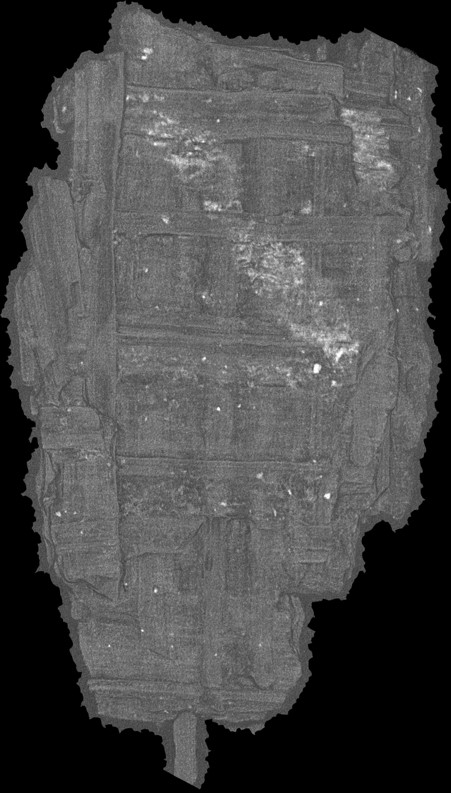
The challenge: investigating the Petra Papyri
The Petra Papyri, discovered in 1993 in a Byzantine-era church in Petra, Jordan, date to around 600 CE. A fire carbonized the scrolls, making them exceptionally fragile even as it helped preserve them over centuries. Many documents have been read, but some scrolls and fragments remain too damaged to decipher.
Some of the surviving material consists of small, thin pieces of carbonized papyrus, sometimes called “flakes.” A single fragment can contain multiple layers, including surfaces that cannot be examined directly. Working with the American Center of Research (ACOR) in Jordan, the University of Kentucky’s EduceLab set out to investigate whether hidden ink could be detected without unfolding or damaging these vulnerable pieces.
Experience from the Herculaneum scrolls
EduceLab brought experience from research on the carbonized Herculaneum scrolls, where closely packed wraps of papyrus make physical unrolling risky. That work has helped advance virtual unwrapping: using three-dimensional X-ray data to identify the surfaces of a rolled manuscript and computationally examine or flatten them without opening the scroll.
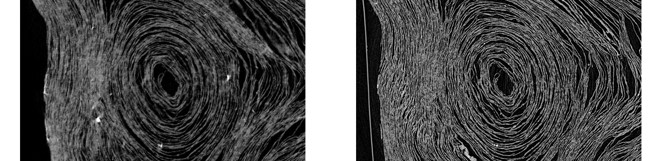
Two cross sections from the Herculaneum work illustrate the importance of imaging the internal structure. The 2009 image was acquired with a SkyScan 1173 micro-CT scanner; the 2019 image came from scans at the Diamond Light Source synchrotron. Both reveal the complex arrangement of layers that a virtual unwrapping workflow must distinguish. These are Herculaneum examples, not scans of the Petra fragments.
Why combine imaging methods for Petra?
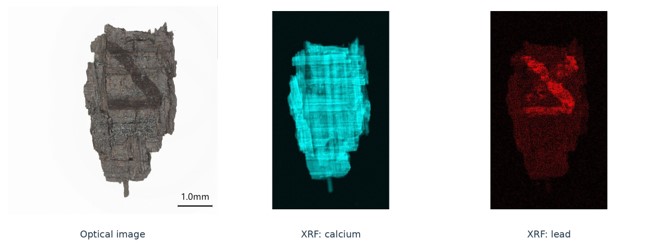
Optical microscopy shows visible surface features; scanning X-ray fluorescence (XRF) maps elements associated with the papyrus and ink; and micro-CT reveals internal structure in three dimensions. The researchers combined these methods to investigate where ink might lie beneath the surface.
To prepare, EduceLab made and carbonized papyrus using period-appropriate materials, then used these samples to refine handling, mounting, and scanning procedures before proceeding with XRF and micro-CT scanning.
XRF maps of the Petra fragments showed that calcium followed papyrus fibers, while trace lead correlated with the ink visible on the surface. High-energy lead signals also suggested a hidden ink-bearing layer, providing a target for micro-CT.
Micro-CT adds the third dimension
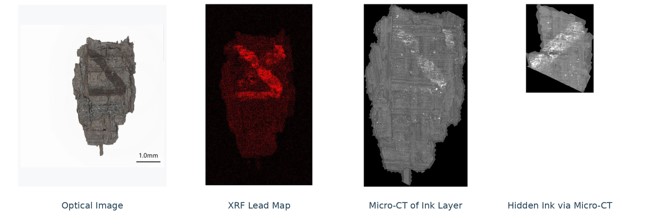
XRF provided valuable information about the elemental composition of the papyrus and its ink, but not a complete three-dimensional picture. By correlating XRF lead maps with micro-CT data, the researchers were able to identify both the exposed ink-bearing layer and an underlying layer containing ink, consistent with the XRF findings.
The study served as a proof of concept for applying complementary imaging technologies to the Petra Papyri. Although the fragments are too small to contain much more than a single character, the results demonstrate how the techniques work together to reveal otherwise inaccessible information. Optical microscopy documents visible surface features, XRF helps identify ink-associated elements, and micro-CT provides the three-dimensional structural information needed to locate ink within the overlapping papyrus layers.
While this preliminary work was not intended to recover extended passages of readable text, it provides a promising foundation for further micro-CT imaging and virtual unwrapping of intact papyrus scrolls from Petra. Building on EduceLab’s experience with the Herculaneum scrolls, researchers hope to use computational techniques to digitally separate and examine inaccessible surfaces, potentially revealing hidden writing without physically unfolding or damaging these irreplaceable documents.
Additional resources
https://educelab.engr.uky.edu/
Seales, W. B., Parker, C. S., Segal, M., Tov, E., Shor, P., & Porath, Y. (2016). From damage to discovery via virtual unwrapping: Reading the scroll from En-Gedi. Science Advances, 2(9), e1601247. https://doi.org/10.1126/sciadv.1601247
Seales WB, Griffioen J, Baumann R, Field M. Analysis of herculaneum papyri with x-ray computed tomography. In: International Conference on nondestructive investigations and microanalysis for the diagnostics and conservation of cultural and environmental heritage; 2011.
Seales WB, Delattre D. Virtual unrolling of carbonized Herculaneum scrolls: Research Status (2007– 2012). Cronache Ercolanesi. 2013; 43:191–208.
Nicolardi, F., Parsons, S., Delattre, D., Del Mastro, G., Fowler, R. L., Janko, R., Reinhardt, T., Parker, C. S., Chapman, C., & Seales, W. B. (2024). Revealing text from a still-rolled Herculaneum papyrus scroll (Pherc.Paris. 4). Zeitschrift für Papyrologie und Epigraphik, 229, 1–13. http://www.scopus.com/inward/record.url?scp=85201431305&partnerID=8YFLogxK
Bhattacharyya, A., Parker, C. S., & Seales, W. B. (2024). Multispectral imaging of damaged sacramental journal pages: A preliminary study. Proceedings of the 4th International Conference on Frontiers in Computing and Systems — COMSYS 2023, 659–679. https://scholars.uky.edu/en/publications/875dd80c-c753-4132-bb54-bb74a36e0377
Seales, B., & Chapman, C. (2023). Nouvelles avancées techniques dans la lecture des papyri d’Herculaneum. Comptes rendus des séances de l’Académie des Inscriptions et Belles-Lettres, 167, 759–770.
Chapman, C., & Seales, W. B. (2022). Arch-Tech: Reading “invisible” Dead Sea Scrolls. Biblical Archaeology Review, 48(4), 25–26.
Dilley, P. C., Chapman, C., Parker, C. S., & Seales, W. B. (2022). The X-ray micro-CT of a full parchment codex to recover hidden text: Morgan Library M.910, an early Coptic Acts of the Apostles manuscript. Manuscript Studies: A Journal of the Schoenberg Institute for Manuscript Studies, 7(1), 162–174. https://doi.org/10.1353/mns.2022.0003
Chapman, C., Parker, C. S., & Seales, W. B. (2022). Virtual unwrapping: A computational approach for reading damaged manuscripts. In Textual history of the Bible online (Vol. 3). Brill. https://doi.org/10.1163/2452-4107_thb_COM_225869
Chapman, C. Y., Parker, C. S., Bertelsman, A., Gessel, K., Hatch, H., Seevers, K., Brusuelas, J. H., Parsons, S., & Seales, W. B. (2021). The digital compilation and restoration of Herculaneum Fragment P.Herc.118. Manuscript Studies: A Journal of the Schoenberg Institute for Manuscript Studies, 6(1), 1–32. https://doi.org/10.1353/mns.2021.0000
Parker, C. S., Parsons, S., Bandy, J., Chapman, C., Coppens, F., & Seales, W. B. (2019). From invisibility to readability: Recovering the ink of Herculaneum. PLOS ONE, 14(5), e0215775. https://doi.org/10.1371/journal.pone.0215775